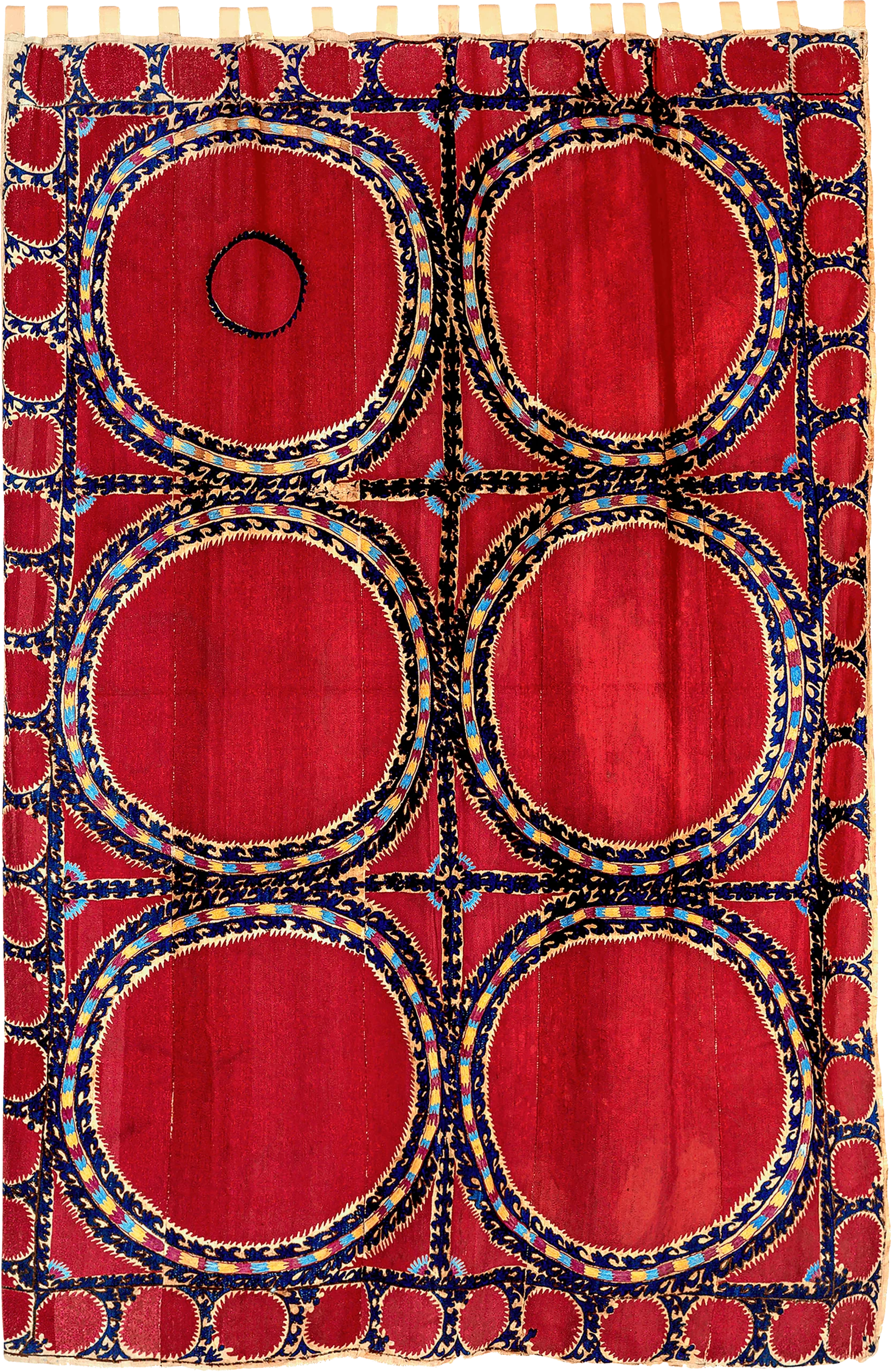
This very striking suzani I found in Kabul in the 1970’s. and was the first suzani I purchased. It proved my introduction to the beauty and uniqueness of 19th century Central Asian embroideries. The large-scale circular motifs (called “moon discs” or palak) arranged in a grid pattern are the hallmark of pieces from Tashkent. The bold, geometric approach with these dominant circular forms, combined with the specific colour palette of deep red ground with black, white, and touches of yellow/gold embroidery, also confirm an origin from this region – the capital of Uzbekistan. What is rare is the sheer size of the circles and the amount of embroidery involved. They represent celestial bodies, particularly the sun or moon, which held deep symbolic meaning in Central Asian culture. They also symbolize fertility, prosperity, and protection. The circles can be interpreted as life-giving forces and are often associated with feminine power and family continuity. Another unusual feature is the single black circle (or outlined disc) within the top-left medallion which likely represents either the “eye” of the sun/moon motif or serves as a protective element—an “eye” to ward off evil spirits. However, it may also simply be an aesthetic choice to create visual interest and break the symmetry.
The visible wear, fading in certain areas, and the handmade quality of the stitching all attest to its age and authenticity. It probably dates to early 19th century.
