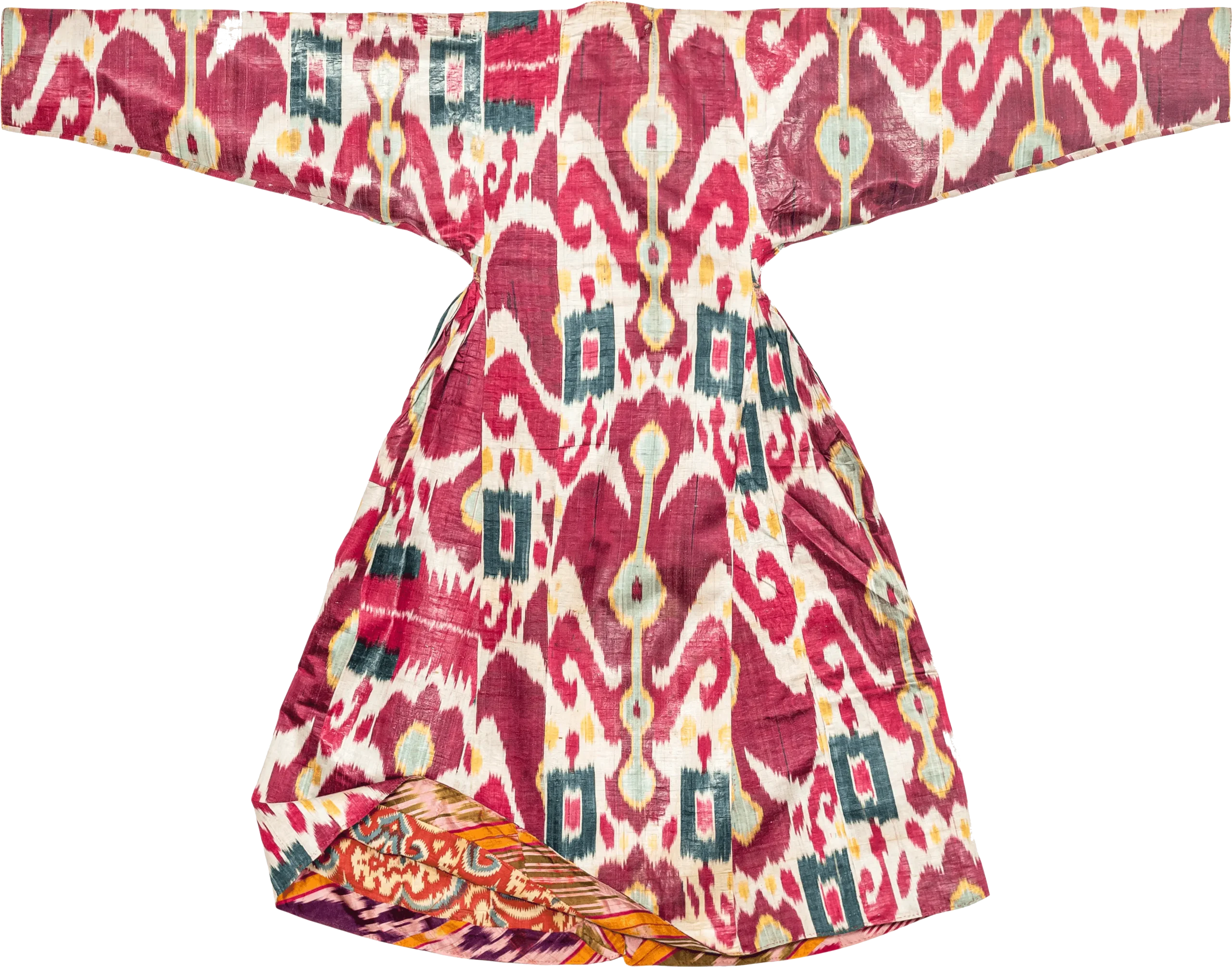
This beautiful chapan would have been an outer garment worn by a man and made from exceptionally fine ikat. The ikat fabric from which the chapan is made would almost certainly have come from the Ferghana Valley which in the 19th century was a major centre of ikat weaving. The colours – deep magenta-crimson, teal-green, ivory/white, with accents of amber-yellow and pale blue – are signature colours of the Fergan Valley ikat workshops, particularly those of Margilan and Namangan, which supplied much of the cloth used by Bukharan tailors. The magenta could be a natural dye or an aniline one – thus dating the coat to the late 19th century.
The dominant motifs are the large, upward-surging forms that dominate the composition — the great arching, flame-shaped elements in deep crimson-magenta against an ivory ground — are the most powerful and characteristic motifs in the Central Asian ikat tradition. They are variously interpreted as flames, feathers, pomegranate forms, or abstracted cypress trees. Their verticality and upward aspiration gives them an unmistakable sense of spiritual energy. The rounded, lozenge-shaped or circular medallions derive from the almond (bodom) or paisley motif (bodom means almond in Uzbek/Tajik). Found in numerous suzanis and ikats, this is one of the oldest decorative motifs in Central Asia as well as in shawls from Mughal India.
The lining, as in many chapans is in a contrasting fabric and probably came from Russia.
