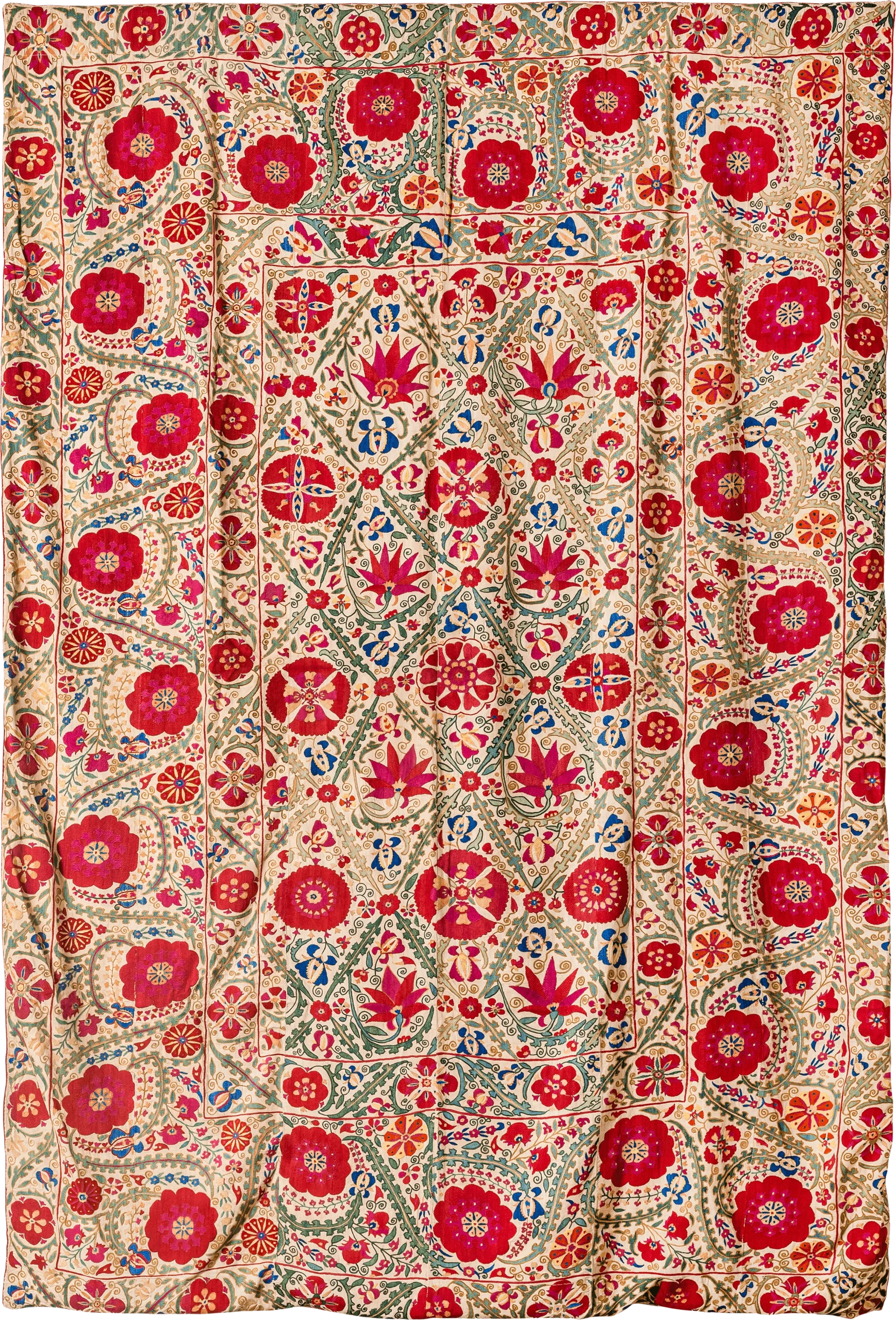
The most striking feature of this suzani is the multitude of rosettes of different shapes and sizes that fill the surface area. They represent flowers, celestial bodies, and the wheel of life; symbols of fertility and abundance. At the center is a starburst medallion which is the focus of the piece and creates a sense of cosmic order. This is an outstanding Bukhara embroidery from the early part of the 19th century. It is densely worked and as a wedding piece created by the bride and her family before marriage is rich in the symbolism that surrounds marriage and the beginning of a new life. Characteristic of a Bukhara suzani, the rosettes are connected by an intricate network of curvilinear vines, tendrils, and flowering stems . This continuous vine system creates an elegant lattice that unifies the composition. Small flowers, buds, and palmettes emerge through the lattice. Cultural influences would include the Persian Garden, the Timurid artistic legacy and pre- Islamic motifs.
