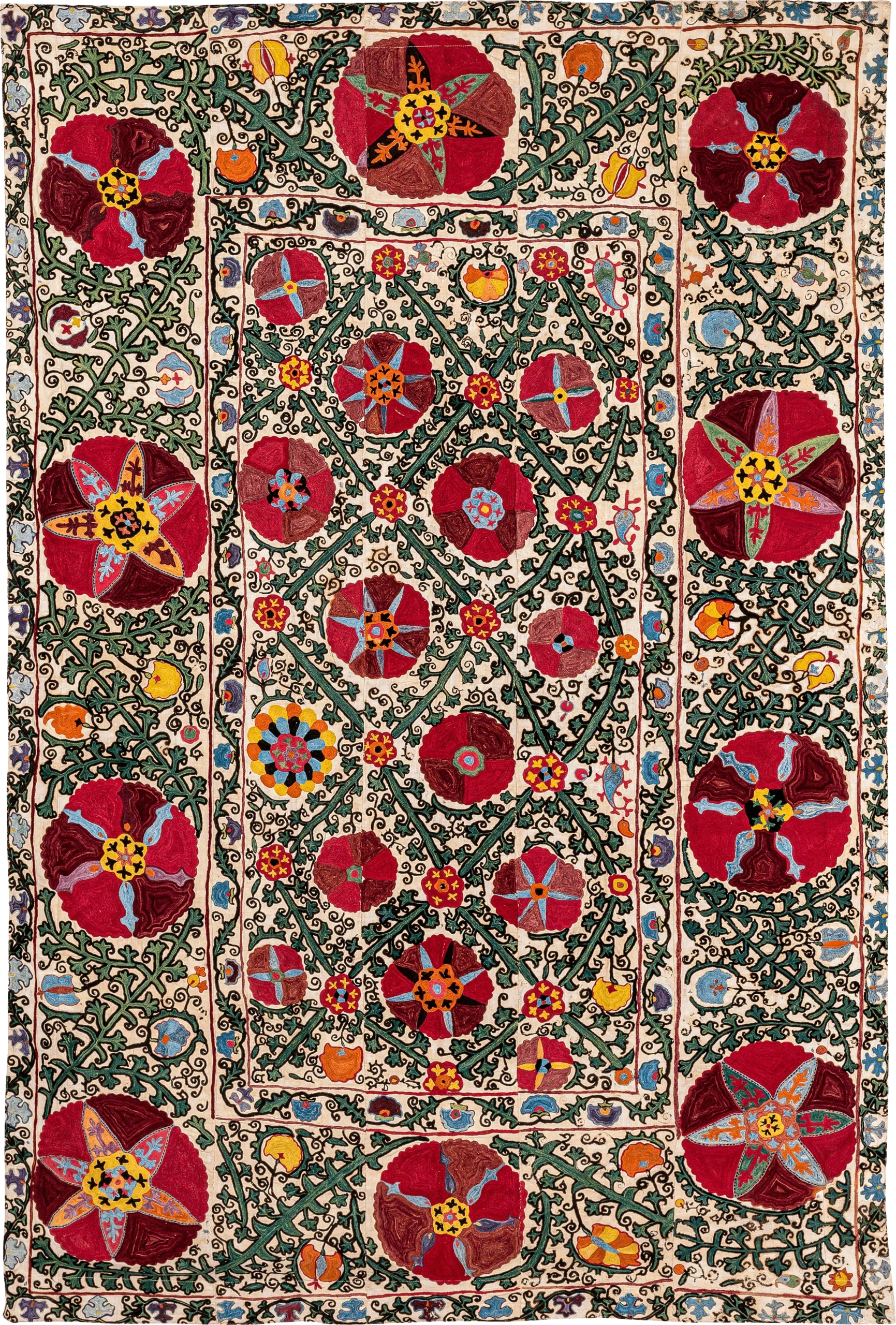
The most striking feature of this suzani is the sinuous, scrolling ,dark green vine that is characteristic of Bukhara. It draws directly from Persian garden and arabesque traditions symbolic of the eternal garden promised in Islamic thought. The dense, almost architectural quality of the tendrils , with their deeply lobed leaves and tight spiralling offshoots, distinguishes it from the more open, airy vine-work seen, for example, in Samarkand suzanis. The large circular red medallions — gol (flowers) — are in tones of red and crimson made from madder that was cultivated extensively in the Ferghana Valley. Each medallion contains a stylized rosette or star form at its centre, rendered in contrasting blues, yellows, and greens. This radiating star within a circle is a motif with deep roots. It echoes pre-Islamic solar symbolism and Zoroastrian cosmology (Bukhara was a major Zoroastrian centre before the Arab conquest in the 8th century). The piece dates to the second half of the 19th century.
