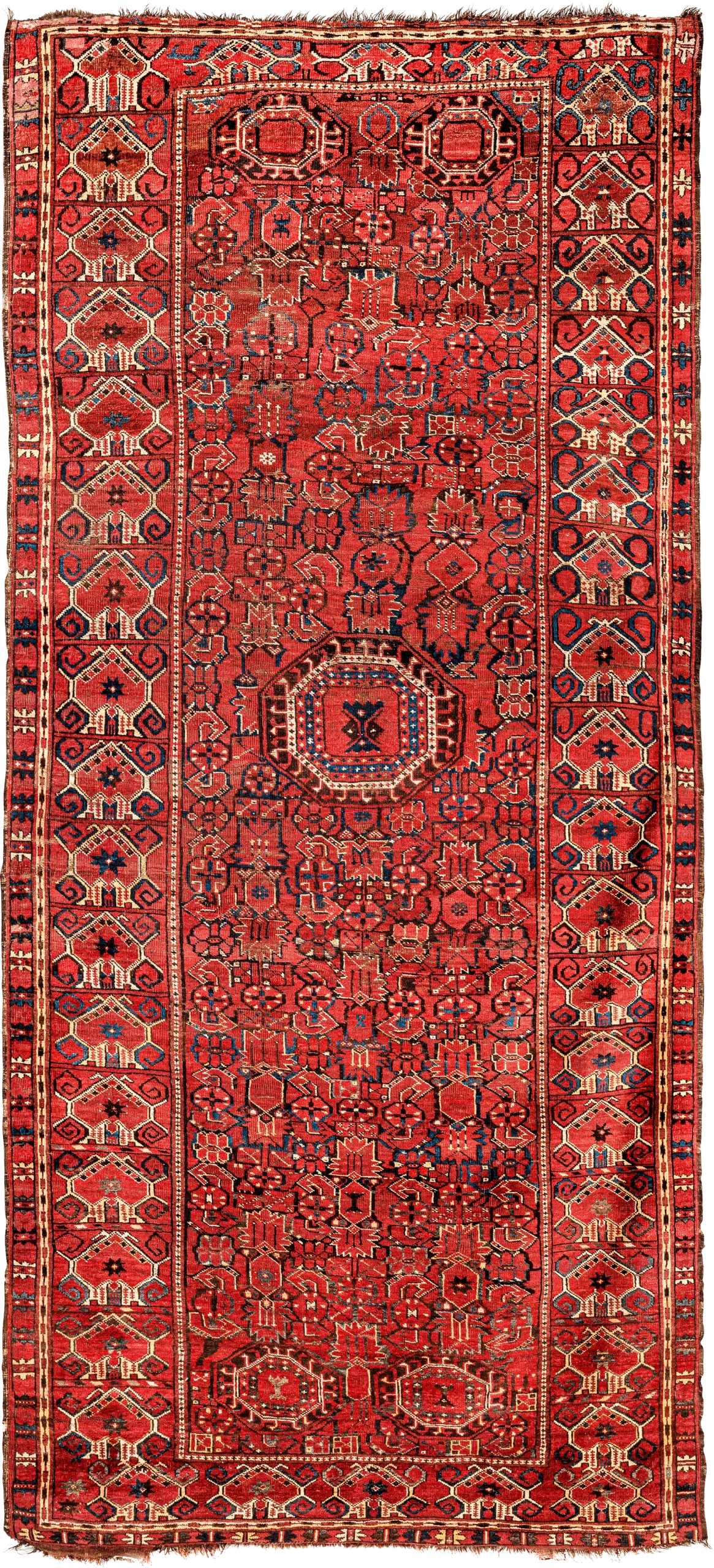
The most striking feature of this rug are the diamond lattice shaped forms around the borders that give an almost architectural framework to the piece. They can be variously interpreted as double-headed eagles which are a motif in Byzantine heraldry, as drawn from Seljuk iconography, or ancient protective symbols. They can also be seen as stylised birds in confronted pairs or ancient abstract zoomorphic forms that reference power and protection. But their use as a major element in this rug reflects the rich traditions across borders on which Ersari Beshir weavers drew. The field has a central prominent medallion of a fortress or hauz (Persian water tank) shape seen in several Beshir rugs. There two smaller medallions at either end. The rest of the field is densely packed with various geometric elements including small hexagons or octagons and stylised floral or star forms. The dominant colour is a deep madder characteristic of the mid 19th century. The piece would probably have been made for domestic, local use rather than as a commercial item.
