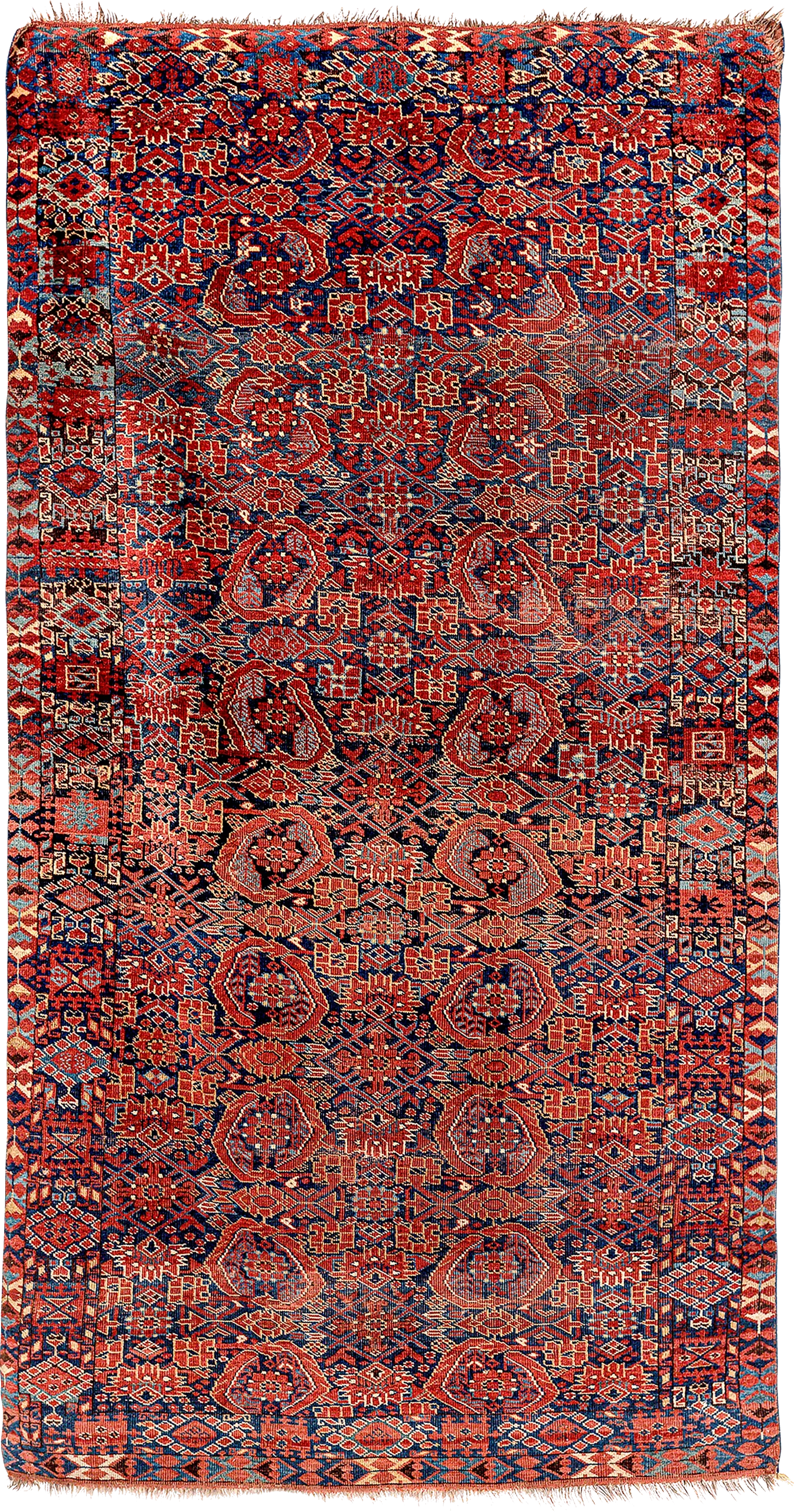
This is probably the earliest rug in the collection, a Beshir dating from the late 18th century or early 19th, and an exceptionally rare example. The design is dense and highly complex with a vast array of motifs that flow in a pattern that uses a characteristic Beshir colour palette. But unlike later Beshir rugs, Turkmen influence seems minimal even though the central Amu Darya region had a largely Turkmen (Ersari) population. The circular or rounded medallions that run though the centre of the piece seem mostly influenced by antique Chinese cloud-collar designs ubiquitous in Chinese textiles and collar decoration on robes. Between and around these circular forms are numerous smaller geometric elements – diamonds, hexagons, stepped polygons, and angular connecting devices. It is difficult to determine the precise origins of these. But it is tempting to see these geometrical and organic forms as drawing on the rich iconic heritage of Central Asia – Sogdian and Bactrian motifs as these civilisations flourished in the Amu Darya region: Timurid influences as Timur was also born in nearby Shahkrisabz: Chinese and Persian influences drawn from the culture of the Silk Road. The colour palette is typical of Beshir – a navy-blue field with rust-reds, coral, ivory, touches of turquoise. Certainly the iconography would have carried cosmological meaning including symbols of celestial bodies and of protection, fertility, and prosperity.
