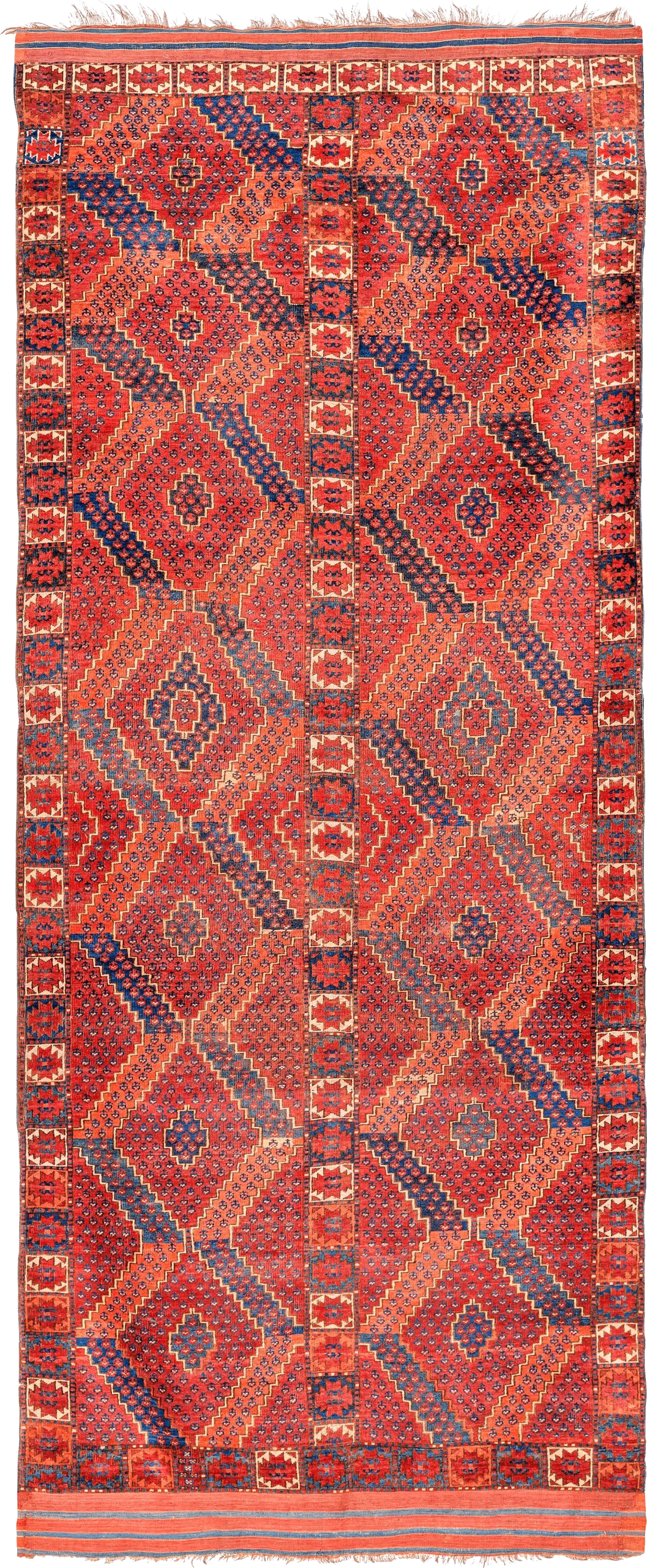
A beautiful mid-19th Beshir with a bold diagonal lattice design with bands in alternating colours that create a dynamic structure and a bold sense of movement. Running down the centre and repeated on the borders are columns of distinctive small square or rectangular medallions in contrasting colours. The rug is in a rich colour palette of rust-red, terra-cotta, coral, burgundy and indigo. The overall design echoes the diagonal lattice and zig-zag forms that feature in Cenral Asian gilims and flat weave designs. Gilims were not common to Beshir where mostly pile rugs were woven. But in exchange of designs and motifs between different regions, weavers in Beshir would certainly be aware of these more abstract designs.
The diagonal lattice pattern also shows a strong connection to Caucasian rugs and gilims particularly from the Kazak region and Karabagh. The rug probably dates from the mid to late 19th century. It reflects the creative vitality of 19th century Beshir weaving – not merely copying established patterns but actively innovating by drawing on multiple design sources and possible architectural ornament.
