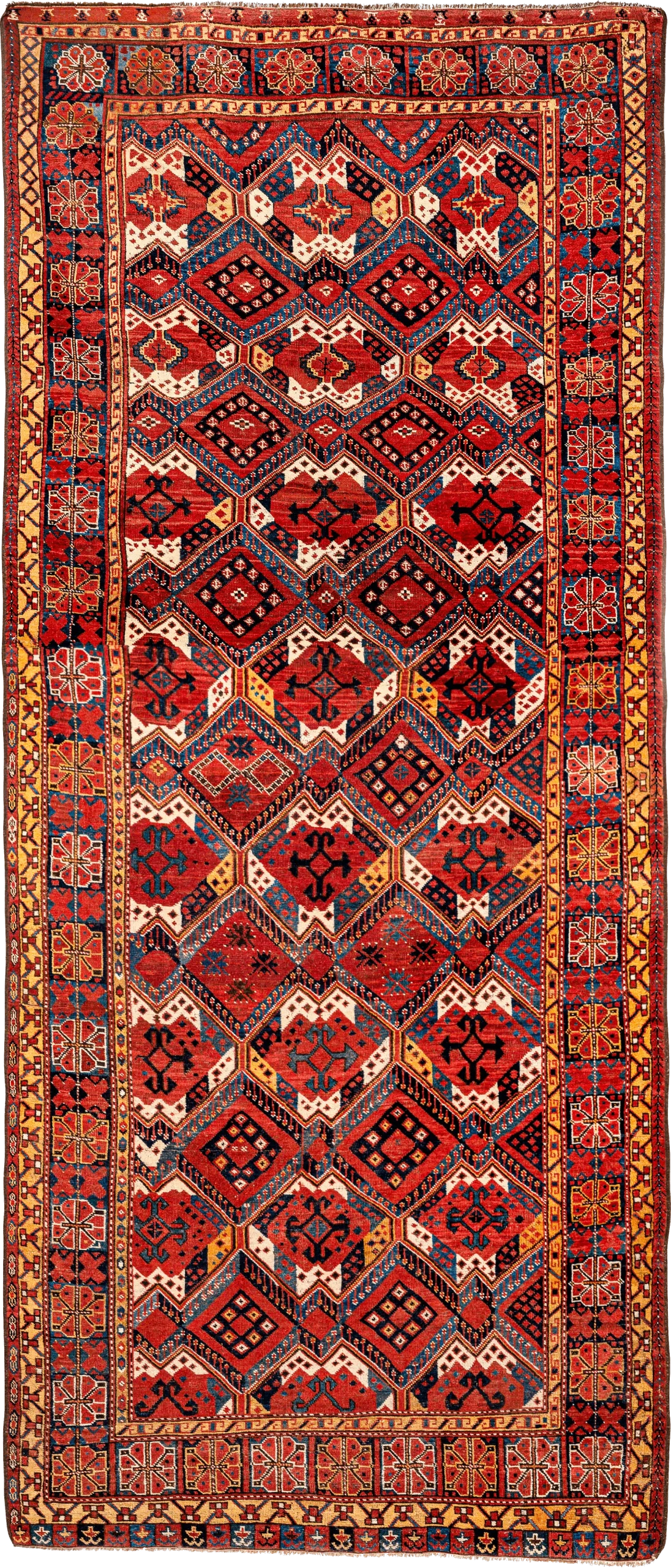
Beshir Rugs were named after the small town of Beshir on the southern banks of the Amu Darya but probably actually woven nearby. They were known as Beshir in the market of Bukhara which was also close. They were woven by Turkmen (mainly from the Ersari tribe)t who had settled and were no longer nomadic. But Beshir rugs break away from the Turkman format and are much more innovative and varied in both colour and design. This is a superb example from the mid 19th century that shows the sophistication of Beshir weavers who draw on elements of Turkmen tradition while incorporating more cosmopolitan design elements.
The rug features a distinctive Beshir lattice or trellis pattern created by diagonal lines that form diamond-shaped compartments across the field. There are echoes of Tekke rugs in this. Within each diamond compartment sits a smaller diamond or lozenge motif, often filled with geometric designs and small floral elements. In the field there is a complex interplay of colours: deep reds, navy blues, rust, golden yellows, and ivory, creating a rich, almost jewel-like effect. The border system is characteristic of Beshir work, with multiple guard stripes and a main border featuring what appears to be a stylized floral or geometric repeat pattern. Beshir weavers drew inspiration from multiple sources including Persian urban carpet designs (evident in floral motifs and lattice patterns): Caucasian geometric traditions: Central Asian decorative arts.
