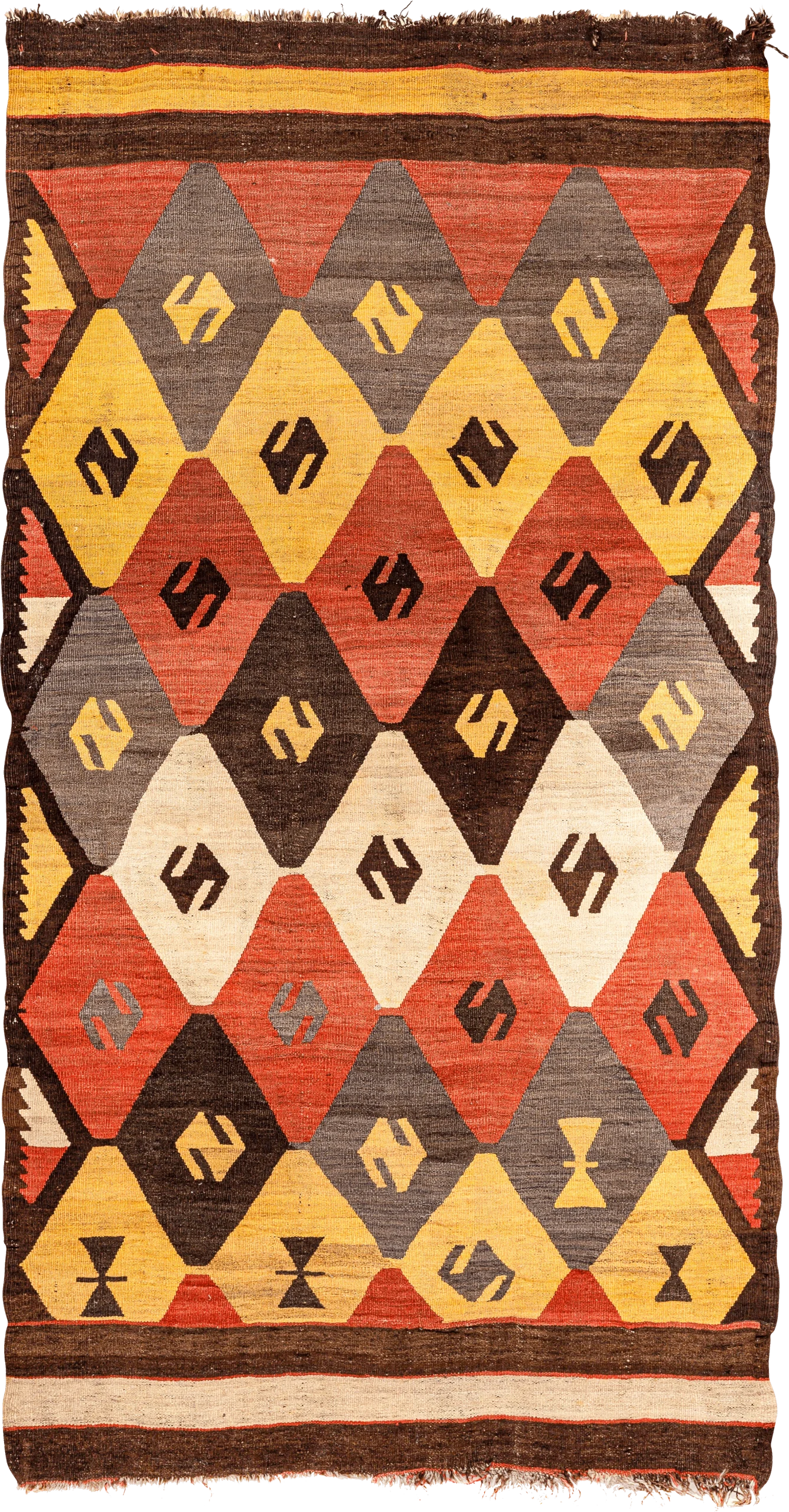
This is a rare piece woven by a small Arab community that was settled in southern Uzbekistan close to the Afghan border. They made these gilims for their domestic use and few have survived. There are some in the Smithsonian Museum in Washington. They were woven in a limited range of five or six colours – a brownish red produced with madder, orange, dark blue, dark green, white, and black. The design is of a classic diamond lattice pattern with alternating coloured diamonds. Each diamond contains small geometric motifs that appear to be stylized ram’s horns or bird forms – common symbolic elements in Central Asian textiles representing protection, fertility, and prosperity. The gilim is in a slit-tapestry weave , where different coloured wefts create the pattern without a pile. The natural colour variations and slightly irregular geometry are hallmarks of hand-woven nomadic textiles from this period.
