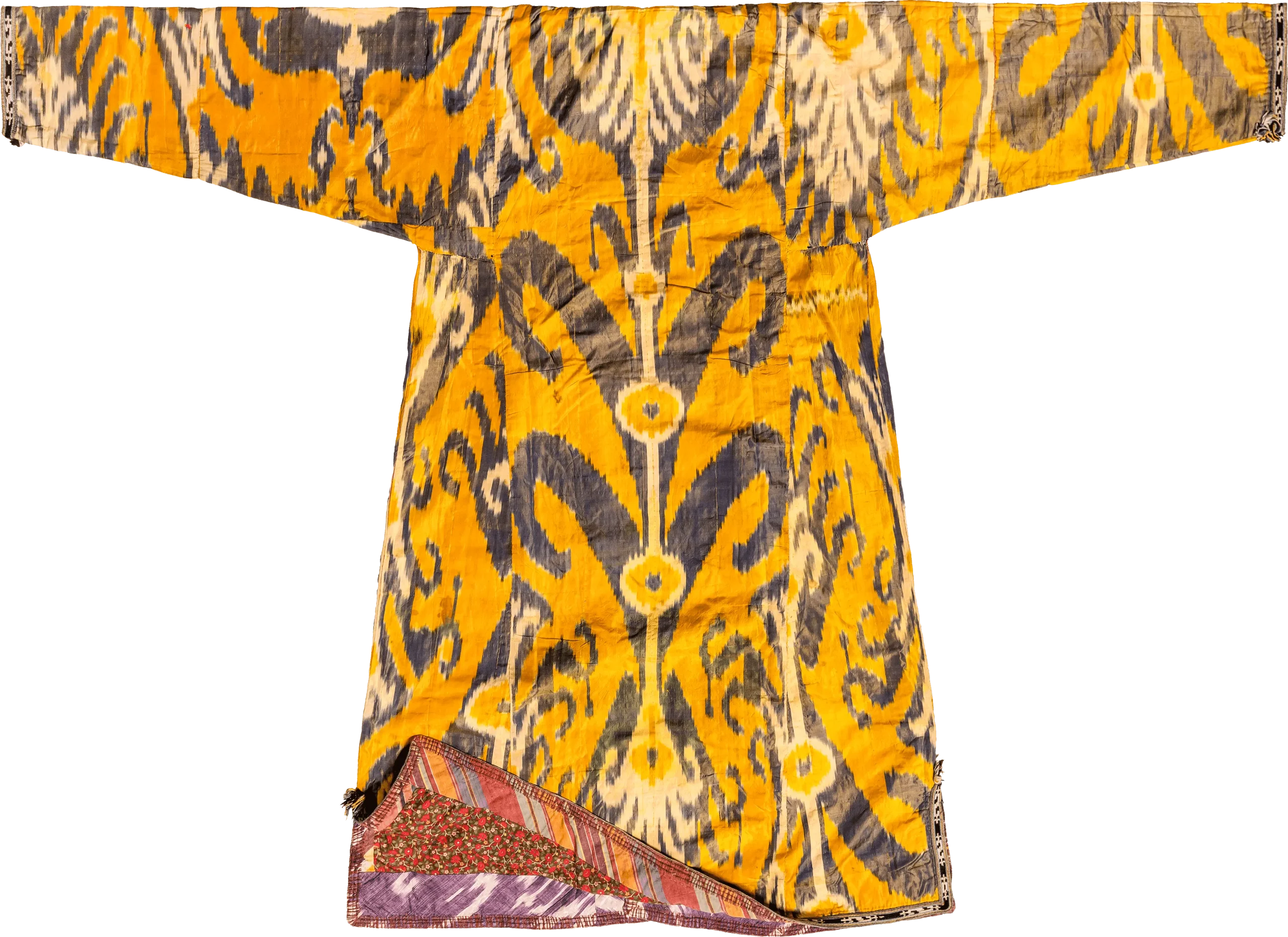
Most likely made for a man, this chapan in a brilliant vibrant yellow would have been a prestige piece. Yellow/gold was particularly favoured by wealthy men and religious/scholarly figures. The colour was almost certainly made from pomegranate rind. The silk threads would have been resist-tied (bound tightly) in patterns before dying, then dipped multiple times in the yellow dye bath to achieve this saturation. The intensity and evenness of this yellow suggests high-quality dye work and multiple immersions, indicating this was an expensive, much-valued garment. The yellow would have symbolized wealth, joy, and possibly spiritual illumination – yellow/gold was associated with divine light in Islamic mysticism.
It was probably made in Bukhara in the mid to late 19th century – though possibly in the Ferghan Valley which was also a wealthy area. Viewed from the back, the dominant feature is the sweeping wing-like or flame motifs in indigo radiating from the central axis. In such robes religious symbolism was important. The sweeping curves might symbolize birds, angels, or spiritual ascension. The pendant forms that hang downwards from the central axis suggest protective amulets. While the graphic patterning is so strong, it is easy to forget how complicated it was to make such an ikat piece with both natural dyes and each thread resist dyed individually and spaced precisely to form the pattern.
