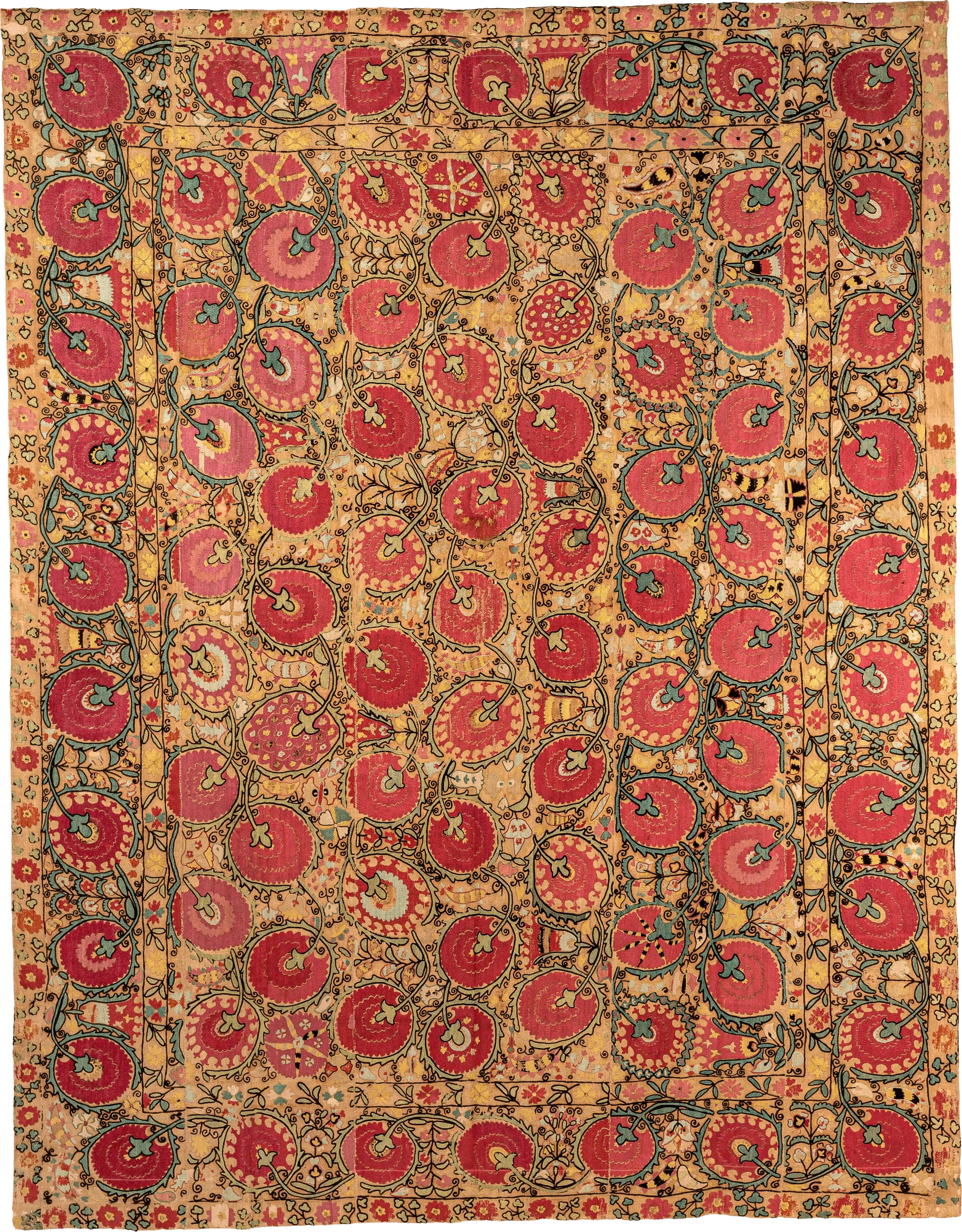
Similar in colour palette and in style to the Ferghana Valley suzanis is this handsome piece from Urateppa ( now called Istaravshan ) just to the west of the Valley in northern Tajikistan. Urateppa was an important trading city on the Silk Road with links to Samarkand as well as to India via the mountain passes into Kashmir and Punjab and through Afghanistan to Delhi and Lahore. This a superb piece with the field dominated by badam (almond ) motifs – an adaptation of the paisley design so reminiscent of Mughal textiles. The badams are rendered as circular medallions and arranged in a grid. Curving stems with small leaves connect the major motifs. There is a dense infill of floral motifs that resemble the sprigs and buds found in Indian chintz and painted cotton textiles (kalamkari) The combination of pinks, corals, and golds is also found in Indian textiles. Situated to the east of the main suzani centers like Bukhara, they are less influenced by the style of the Uzbek khanates. They are more exposed to influences from further east (China) and to the South (India). They nonetheless retain a legacy that goes back to the pre-Islamic Sogdian heritage and to Persian culture. They thus demonstrate how the Silk Road was not just a trade route for goods but also for ideas, aesthetics, and artistic vocabularies.
