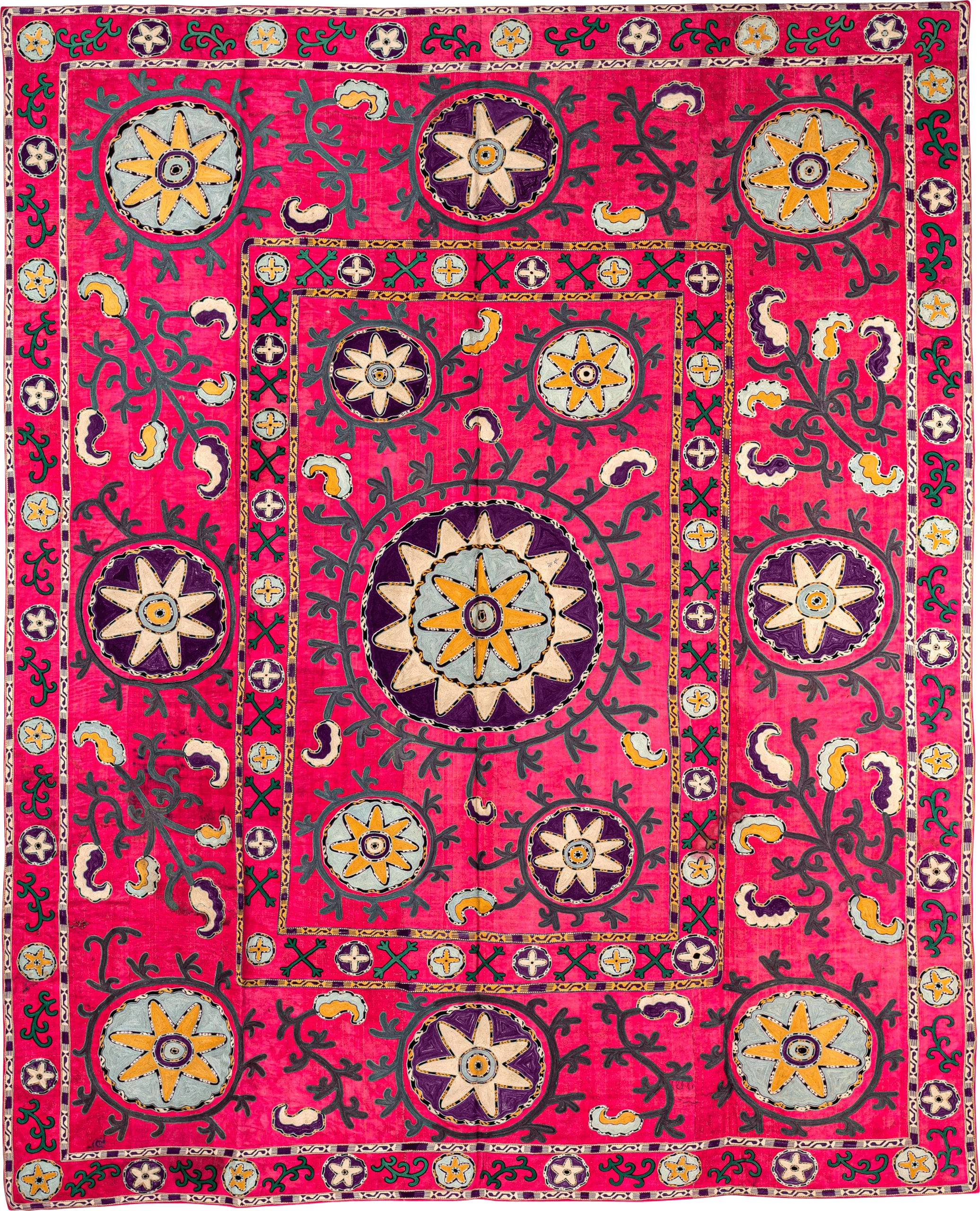
The dominant feature of this suzani is the deep fuscia/magenta ground in adras silk – a highly laborious technique in which each thread is individually dyed as in ikat. The use of adras as the ground fabric (rather than plain cotton) gives greater sheen and indicates a higher-status piece, likely from the mid-to-late 19th century. But the luxurious colour has come with the use of a synthetic dye. Aniline dyes were introduced around the 1860’s -1870smwhich helps date this piece. The striking rosettes are of different shapes, sizes and colours. You can see eight-pointed star rosettes, stylized floral centres within each medallion and paisley-like forms and botanical motifs filling the spaces between the medallions. The embroidery is in a wide range of colours including purple, cream, yellow, light blue, and green. The composition features a classic Bukhara suzani layout which suggests the family employed a professional designer while doing the embroidery themselves. With the use of silk in the ground as opposed to cotton, this was intended a prestige piece.
