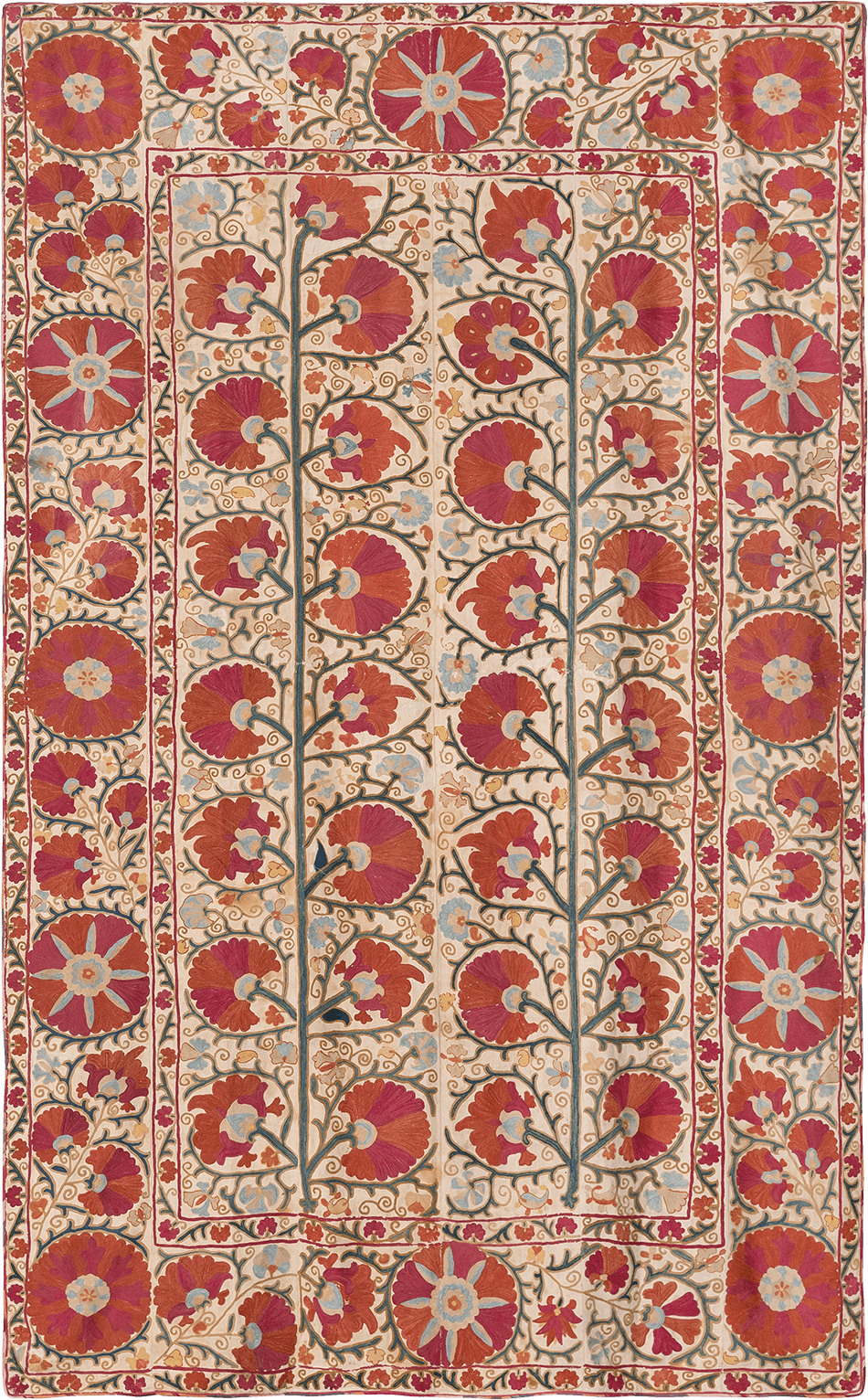
This suzani is dominated by a Tree of Life motif – the depiction of which is rare in Bukhara pieces. It is thus very unlike the majority of Bukhara suzanis that follow a medallion-and-vine format with scattered gol roundels connected by arabesque tendrils across the field.
The Tree of Life motif is familiar in other Central Asian textiles including ikats and rugs as it is in other cultures across the world. What makes this example particularly compelling is the clarity of the statement: two strong vertical trunks rise from the base of the field, branching symmetrically in a herringbone rhythm, each branch terminating in large, full-blown carnation or poppy heads. These stylised flowers and the straight trunk mean that the tree is not the cypress or pomegranate often found in Tree of Life depictions. In the context of a suzani embroidered in Bukhara in the first half of the 19th century it is more likely that it represents the cosmic or World Tree (axis mundi) of ancient Central Asian shamanic and Zoroastrian cosmology. This is the tree that connects the underworld, the mortal realm, and the celestial sphere — its roots in the earth, its crown in the heavens. The stylised carnations and poppies of the tree are very different from the roundels of the border. These are placed at regular intervals like sentinels framing the central narrative. They could be seen as solar discs. This makes for a contrast between the dynamic, vertical, living energy of the tree field and the static, circular, protective medallions of the border. The design of the suzani thus reflects a cosmological structure: the living world at the centre and the eternal protective sphere around it.
