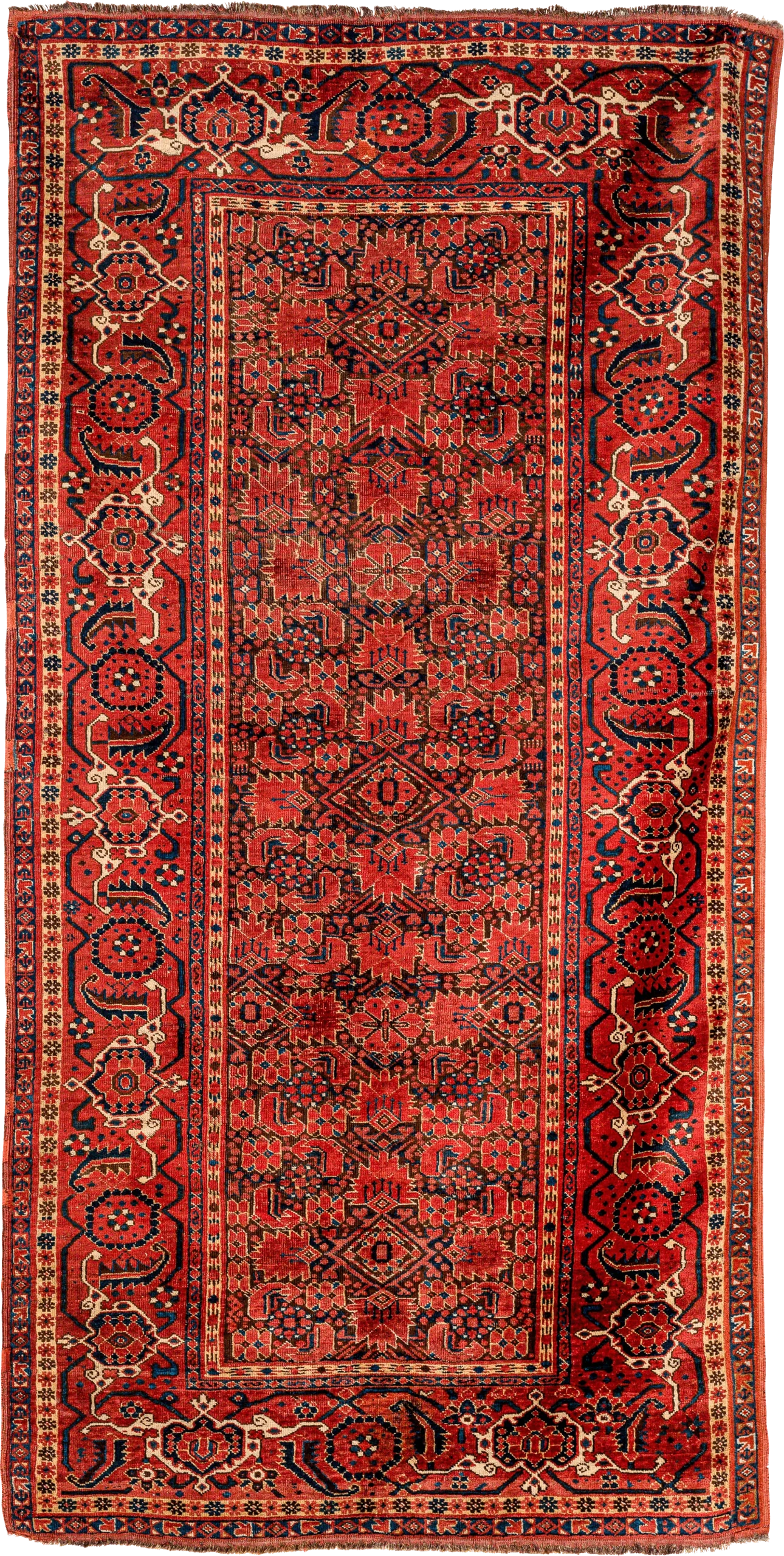
As with rug R 18, the most unusual feature of this piece is the powerful border which is in design terms in complete contrast with the field. It features a large-scale continuous scrolling vine — an arabesque — carrying substantial palmette and floral forms. This is a thoroughly Persian design vocabulary, derived ultimately from Safavid court carpet tradition, and rendered here with considerable vigour and scale. The palmettes are large and confident, alternating with secondary floral forms along the scrolling stem. The colour scheme of the border — ivory or cream vine and floral forms on a deep navy or dark red ground — creates a dramatic contrast. This type of large-scale arabesque border is far more commonly associated with Persian city carpets from Tabriz, Kashan or Isfahan than with Turkmen tribal weaving, and its presence here speaks directly to Beshir’s unique position as a cultural bridge between the Turkmen tribal world and the Persian urban carpet tradition. The field is dominated by a deep madder red ground, upon which is arranged a repeating all-over pattern of geometric floral medallions — large, multi-petalled rosette forms, somewhat hexagonal or octagonal in outline, densely packed in vertical and diagonal rows. The rosettes are rendered primarily in deep crimson and dark navy against the red ground, with ivory or cream highlights picking out their inner details.
The combination of a geometric, tribal-inflected field with a grand Persian-style arabesque border is the defining characteristic of this piece and illustrates perfectly why Beshir carpets occupy such a distinctive place in the history of Central Asian weaving. The Ersari Turkmen of Beshir, settled along the Amu Darya and trading regularly with Bukhara, absorbed Persian design elements — particularly border designs — while retaining a more geometric, tribal sensibility in their field patterns.
The piece probably dates to the mid 19th century or the third quarter.
