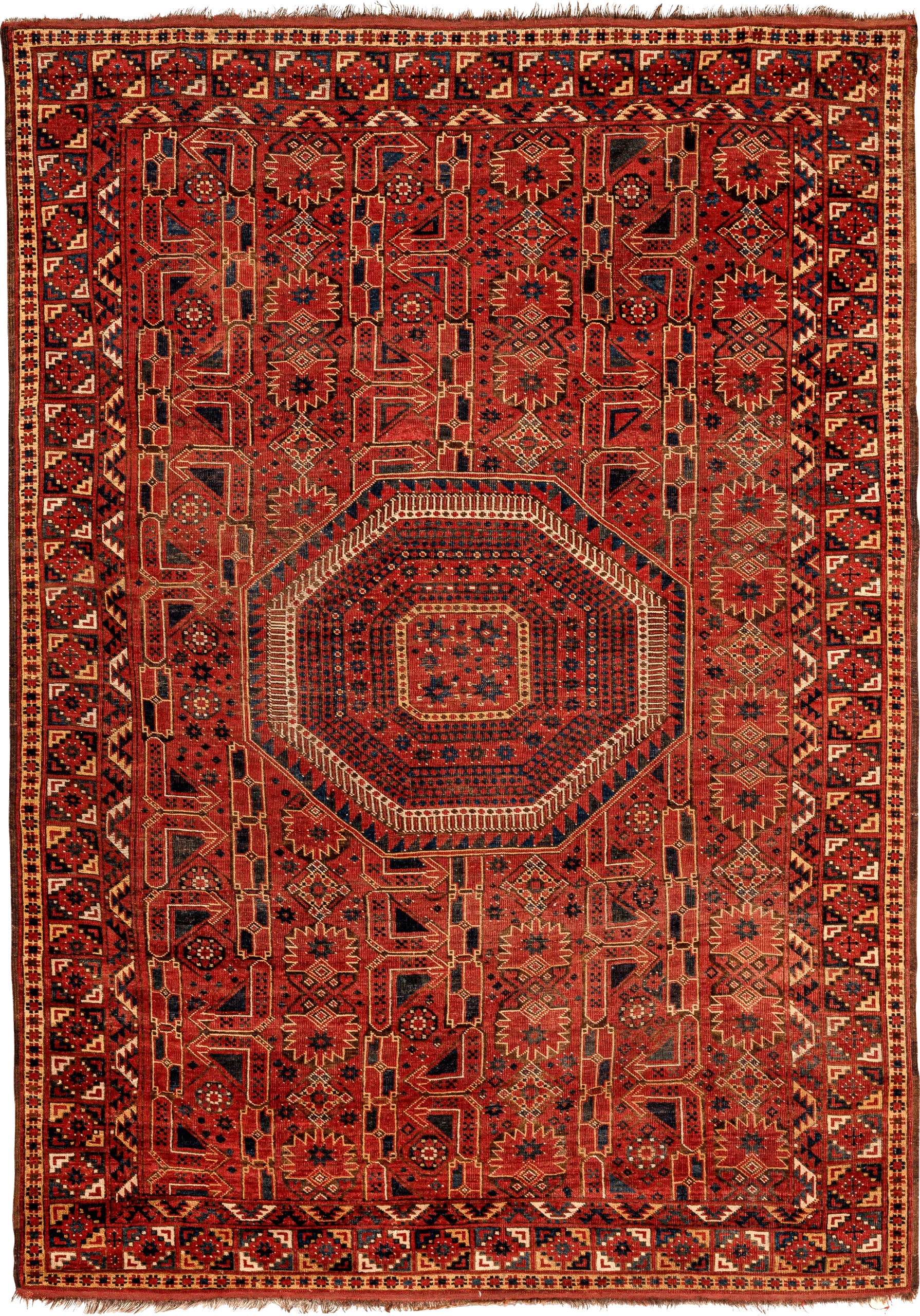
This is a superb example of a Beshir rug from probably the second half of the 19th century with many of the characteristic features of woven pile pieces from this area close to Bukhara and on the banks of the Amu Darya (Oxus river). Though woven by settled or semi settled Turkmen tribes (most likely the Ersari), it breaks from the classic Turkmen format to a more innovative design drawing on various cultural influences of the Silk Route. The most striking feature is the eye-catching large octagonal in the centre of the piece which is variously interpreted as a fortress or a water tank. It is set against a rich rust-red field densely filled with geometric and stylised floral motifs. The main border features a running geometric pattern with reciprocal or interlocking elements, flanked by multiple guard stripes. The octagonal in different shapes and sizes is a signature of Beshir rugs like the gol is of classic Turkmen pieces. The most likely interpretation is that it is a fortified structure or architectural element. But the water tank (hauz) is also a central element of a traditional Persian garden and there is certainly Persian influence in the overall design. There is also the influence of Caucasian geometric vocabulary in the sharp, hooked elements and interconnecting lattice patterns. While the octagonal is in the darker tones of deep burgundy and navy the field is a rust-red characteristic of Beshir.
